Points maxxing
A little glimpse into how I operate and spontaneously full send on trips without ever worrying about budget
Dez · Oct 20, 2026 · 9 min read

The title says it all.
85% of the flights I’ve taken over the past 9 years were redeemed with points/miles. (I’ll talk about the other 15% where cash is used later)
My friends all think I have endless disposable income, but in reality, I’m probably making about as much as they do, if not less. And this is what I preach to everyone: stockpiling points and miles lets you travel luxuriously on a budget. You get the best of both worlds. There are also hidden benefits that aren’t discussed enough, which I’ll point out.
Before we begin, here are my credentials, sort of:
(Approximate balance as of October 2026)
Chase Ultimate Rewards points —> 400k (peak was 1.2M)
American Express Membership Rewards points —> 200K (peak was 700k)
Hyatt —> 101k; Currently Globalist status
Hilton —> 50k (peak 200k); Currently Hilton Gold status
Atmos (Alaska/Hawaiian) —> 35k; Currently Atmos Gold (oneworld Sapphire)
Southwest Rapid Rewards —> 20k (peak 60k)
United MileagePlus —> 1k (just recently burned them all); Currently Premier Gold status
Capital One miles —> 137k
BILT rewards —> 77k
Other statuses include IHG Platinum, Wyndham Diamond, top-tier Hertz and National rental car status, and Sonesta Platinum
Rough total across the portfolio is ~1 million points, scattered across different programs. To the average person, this is a unicorn scenario, but for those deep in this rabbit hole, these numbers are average.
Having a lot of points in the bank is nice, but it’s also important to use them when you can instead of hoarding them like you’re investing in the stock market. I’ve seen time and again that when the economy isn't doing great, reward programs tend to pull back on benefits and perks.
I have to admit, I’m guilty of hoarding some points, but I plan to redeem most of them in the upcoming year. I want to point out that I didn’t get to this point quickly. It took a couple of years to hit these really high numbers. You can hit these high numbers in less than a year, but you’d either have to spend an insane amount of money in such a short time or use riskier methods to achieve this goal.
Before I go into how I churn so fast, I wanna point out the benefits of stockpiling some points and miles
You have flexibility on dates
Don’t know what day you need to fly out?
Need to make a flight change?
Maybe you woke up one day and randomly decided that you want to fly to destination xyz.
The points are here to make that happen! Most people settle on booking basic economy (late-stage capitalism cope) or standard economy fares. While these fares are the cheapest, you lose a lot of the privileges that come with booking a flexible fare —> Think boarding zone, seat selection, higher risk of gate-checking your carry-on, but the worst one of them all— no refunds or changes (maybe you can, but you have to pay a fee).
However, if you used your hard-earned airline miles to book, you operate on a different fare policy. Typically, you pay the fare with your points and pay any applicable fuel surcharges and taxes with cash. The best part is that if you need to change or cancel, you get all your points back and any fees refunded, hassle-free, as long as the flight hasn't departed. Airlines treat award redemptions like standard fares, so you can select your seat for free.
Resistance to peak pricing
Everyone knows holiday travel, especially here in the US nowadays, costs an arm and a leg given the current fuel-price climate. There’s a running joke that it's cheaper to vacation abroad than within the US because domestic flights are so expensive. Booking with miles protects you from peak pricing driven by high demand.
Yes, points costs can rise, but would you rather pay 30k miles for a transcontinental flight or $800-900 on a major holiday?
Orrrrrrr maybe a flight to Asia is $1200 round trip, but the airline wants 50k miles for economy, or maybe you scored a deal for 70k miles in business class. At that point, it’s a no-brainer.
The “point” is that using points gives you options. You don’t plan a trip around the flight; instead, you pinpoint where you want to go and build the itinerary from there. The same principle goes for hotels.
You have more discretionary spending
For every traveler, flights and accommodations are always the biggest drains on your budget. Say they run around $1,000 (a random anchor; prices vary depending on where you travel).
But what if you paid for your flights and your hotels on points? That’s $1,000 back in your wallet to spend on other experiences, like dining, attractions, adventures, and souvenirs.
Trust me, once you start traveling like this, you never want to go back to paying cash for every travel-related expense.
#1 Sign-up bonuses
Unless you’re a business owner or spend a lot each year, sign-up bonuses are the fastest way to build your point stack. The return on your investment with sign-up bonuses is typically 3-5x, sometimes as high as 10x, depending on the card and the bonus the issuer is offering.
For some cards, there might be a cooldown period for how often you can redeem the bonus again, so you can rinse and repeat by closing and reopening cards (does not tank your credit score if you have other long-term accounts open)
This method works best if you have big purchases coming up, like a home renovation, wedding expenses, or a huge tax bill (yes, you can earn points for paying taxes). It’s also the simplest way to earn points: just spend until you hit the bonus threshold.
#2 Referral Links
If you have a player two (your spouse or partner in crime), it's easier to piggyback off each other for card sign-up bonuses. Also, if the rewards program lets you pool or transfer points, you can divide and conquer. I’ve known many people who open the same set of cards using player one's referral link and, after the 1-year mark, close one to avoid redundant annual fees.
Unfortunately, I don’t have a player two to participate in this carousel, but providing my services to clients and asking them to use my referral links in return has given me extra boosts when I’ve needed them most.
#3 Shopping Portals
Beyond the top two rules, optimizing your spend is the next big play to earn points quickly. And I’m not just talking about “making sure to put all dining spend on your AMEX Gold for 4x or Chase Sapphire for 3x”. I’m talking Rakuten, Rove Miles, and Capital One Shopping (pick based on the rewards points you prefer, and stick to one at a time). Spreading them across at once makes them hard to track and could hurt liquidity, since you usually need a minimum balance transfer before you can cash out the points.
The shopping portals are geared towards online spending, but if you check often, there are moments where the offers are crazy:
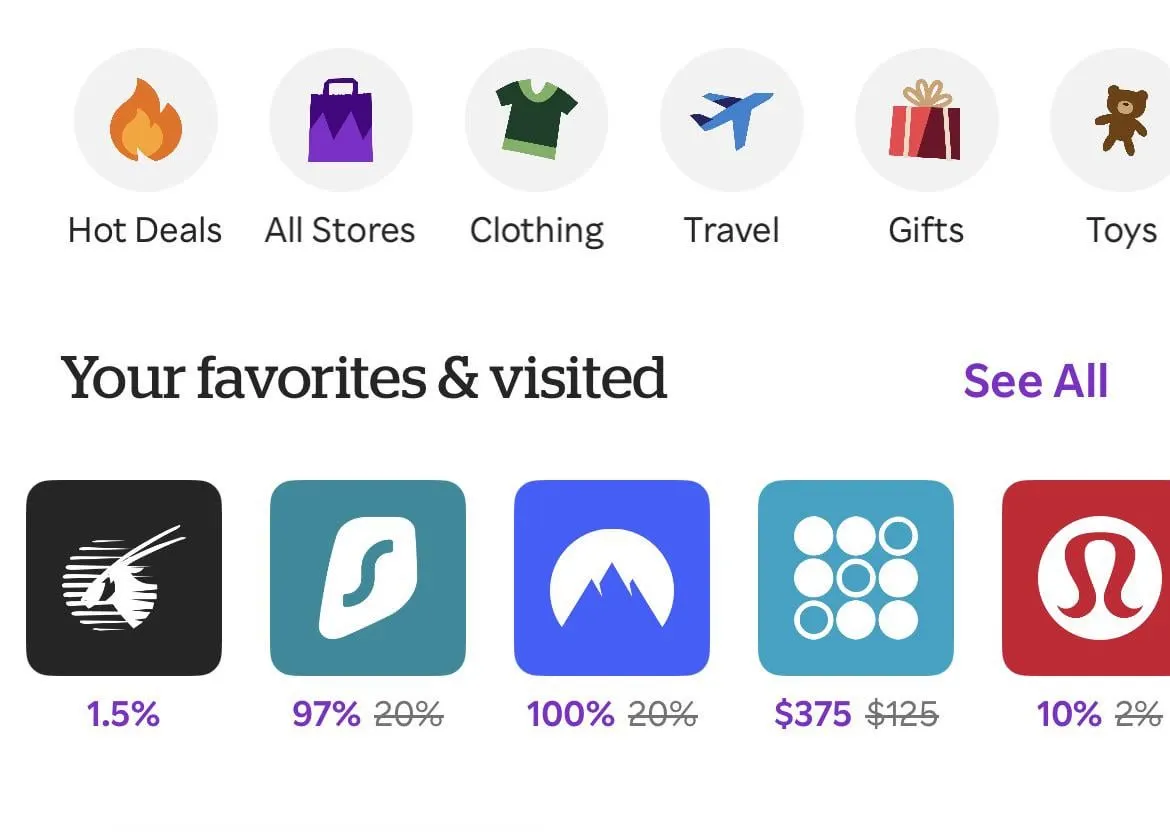
For example, Nord VPN with 100% cashback… that’s another term for 10x back!!! Buying the most expensive plan for $200 would get you $200 back in points, making this VPN subscription effectively free.
The rule of thumb is to never go out of your way to meet spending bonuses; make your everyday spending work for you. Shopping portals are the best way to capture that everyday spend, but they can also serve as an emergency backup if you are short on points (I’ll introduce this hack towards the end)
#4 Business Credit Cards
I know the term "business" may scare you away, but this lesser-known secret can help you stockpile points quickly. These cards are a game changer: they open the door to another world of sign-up bonuses and come with lucrative perks like maxing out spend and not dinging your credit score. If you're past the cooldown period for opening new cards with certain banks, like Chase 5/24, business cards don't count against those rules.
Once again, stacking #1 and #2 doubled your potential to rinse and repeat —> you could hit the 1 million milestone within 6-24 months, depending on how aggressively you can spend.
But don’t I need an LLC to get one?
Not at all! In the U.S., many issuers allow sole proprietors to apply using their own name and Social Security number. Freelancers and people with small side businesses may qualify, depending on the issuer's criteria.
For example, selling items, driving for Uber/DoorDash, or owning an Etsy shop. Any service or product you advertise to people “counts” as a business.
Report your business activity and (anticipated) revenue honestly; you don’t need to invent a business or inflate your income to qualify. The last thing you want is an internal audit from the bank, which usually happens when the reported income doesn't match the financial evidence they see (there is no official cutoff, but expect the bank to ask questions if you report 500k revenue for a business that hasn’t existed yet).
It also helps to have a personal relationship with the bank you’re getting the business cards from (either through personal credit cards or bank accounts), as it strengthens credibility.
#5 Status Challenges
It doesn't necessarily help you earn points, but it does stretch their value.
Status in this context refers to any loyalty tier within a travel program; think airlines like American Airlines Platinum, car rentals like Hertz’s President's Circle, or hotels like Hyatt Globalist. You are more likely to get pampered when you have high status in any program, because they see you as a high-value client due to your brand loyalty.
Earning status with these programs takes time & money, which is why the rewards are more lucrative when you climb their ladder. However, just because you have status with one brand doesn't mean you have to start over to earn status with another.
This is where status match comes in: an agreement between 2 loyalty programs that honors members' status.
A status match (or status challenge) lets you qualify for elite status with an airline you don’t currently have status with.
For example, you may have United Airlines MileagePlus Premier Gold status and plan to start flying Delta Air Lines. You might ask Delta to grant you its Gold Medallion status so you can try out Delta with the same benefits you’ve had with United
Say you have “Best Western Diamond Select” (highest tier) & you want to stay at a Hilton property. You don’t have Hilton status because you spent all your time earning “Best Western Diamond Select,” BUT you can status match for “Hilton Gold” since they have a partnership. This means you can still enjoy perks instead of starting from scratch with another brand. You can repeat this process for other programs, which is a hack in itself.
Note that you are not transferring one status to another—you are collecting an additional status to expand your options for programs where you already have loyalty.
There are 3 types of status matches:
- Reciprocal Status Matches The literal definition of “status match.” These status matches don’t expire as long as the 2 loyalty programs involved remain partners. An example is the existing relationship between Wyndham Hotels & Caesar’s Hotels. As long as you had status with one, you were guaranteed status with the other until you lost one (you could keep it indefinitely with the carousel). You do not have to take any additional action to keep them
- Challenge Status Matches These status matches often require you to meet a specific requirement to keep the status. For example, American Airlines Platinum status can match to Alaska Airlines’ MVP Gold status if you fly 10,000 miles within 90 days. If you do, you keep it for a year; if not, you can't match.
- Trial (Shortcut) Status Matches Like status match challenges, trial matches aren’t guaranteed until you complete the challenge; the difference is that the partner you are trying to match to will let you try the status for a short period. Sometimes a program may offer a shortcut status match. For example, Bilt had a Hyatt promotion where you only needed to stay 1/3 of the nights (20 nights) to reach Globalist status (highest tier), compared to the conventional way (60 nights). They would start you at Explorist (mid tier) for 90 days while you worked toward the goal.
This pretty much sums up all the ways to churn points; there are grey areas like manufactured spending, which can exponentially speed the process but carries the risk of getting shut down, losing all your points, and facing a long-term ban from the bank.
More from the blog

Sep 11, 20268 min read
Jet Lagged 001: Saigon (HCMC), VN
Notes from a rough landing

Sep 10, 20261 min read
Hyatt x Delta Airlines partnership
And a farewell to American Airlines I guess

Sep 8, 20264 min readSubscribers
United expert mode
If anyone ever mentions this, just know that they are locked in on award travel